
The quickest way to compare two website quotes
Use three labels for every line item:
Included
Extra
Unclear
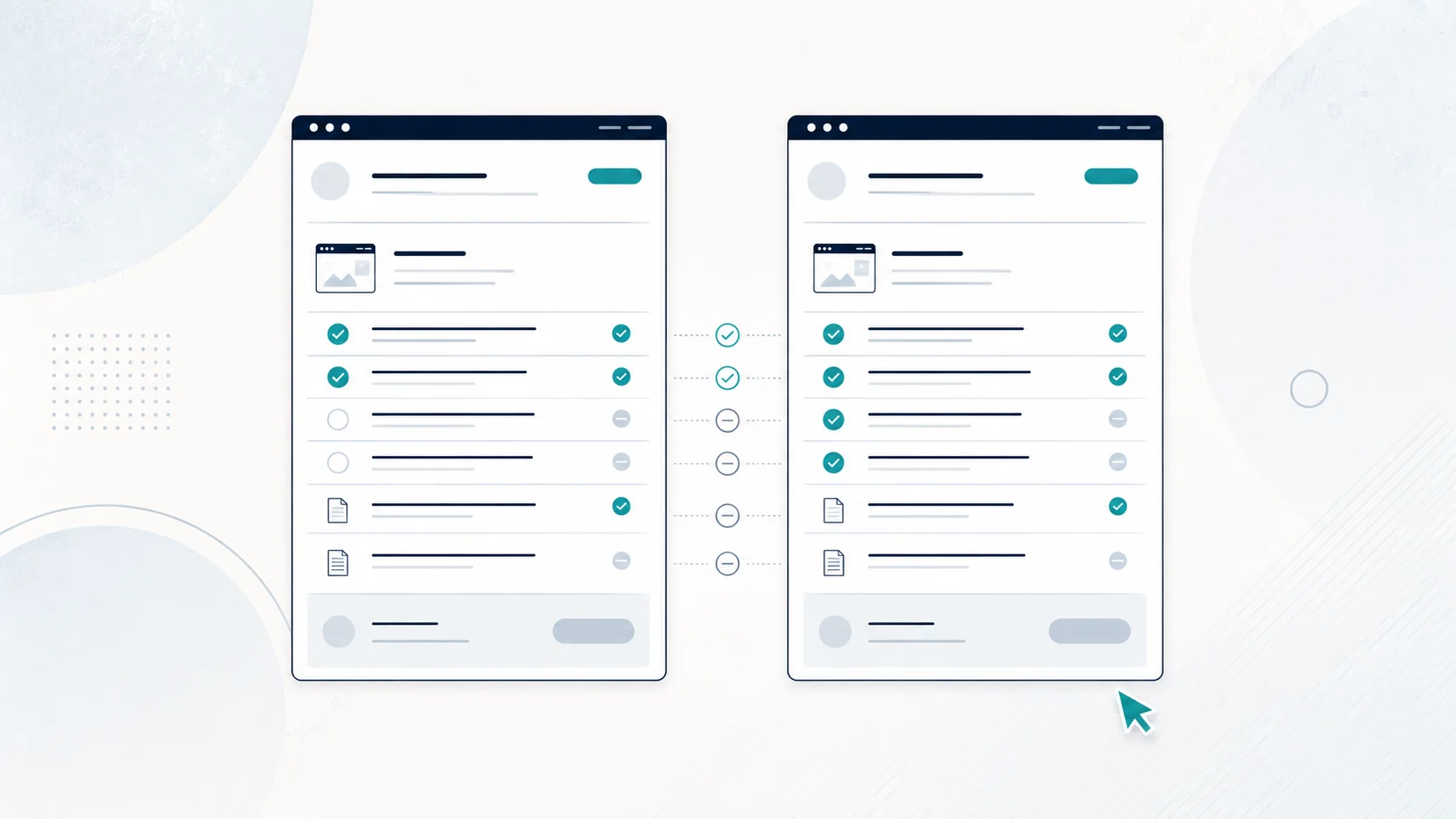
Then compare Quote A and Quote B side by side.
A $900 quote with clear inclusions can be easier to evaluate than a $600 quote that leaves hosting, copy, forms and future fees unexplained.
Equally, a higher quote is not automatically better. You may be paying for services your small business does not need.
Website quote comparison checklist
| Item | Quote A | Quote B | What to check |
|---|---|---|---|
| Build price | Included / Extra / Unclear | Included / Extra / Unclear | Is this fixed, estimated or "from" pricing? |
| GST | Included / Extra / Unclear | Included / Extra / Unclear | Is the displayed total GST-inclusive, plus GST, or not subject to GST? |
| Pages / scope | Included / Extra / Unclear | Included / Extra / Unclear | How many pages or what exact deliverables are included? |
| Design | Included / Extra / Unclear | Included / Extra / Unclear | Customised design, template setup, or something else? |
| Mobile | Included / Extra / Unclear | Included / Extra / Unclear | Is phone/tablet responsiveness part of the build? |
| Copywriting | Included / Extra / Unclear | Included / Extra / Unclear | Who writes and edits the website text? |
| Images | Included / Extra / Unclear | Included / Extra / Unclear | Who supplies photos, licences stock images and optimises them? |
| Domain | Included / Extra / Unclear | Included / Extra / Unclear | Registration cost, renewal, and whose account controls it? |
| Hosting | Included / Extra / Unclear | Included / Extra / Unclear | Price, renewal cycle and what happens if you leave? |
| SEO setup | Included / Extra / Unclear | Included / Extra / Unclear | What does "SEO" actually mean in this quote? |
| Forms | Included / Extra / Unclear | Included / Extra / Unclear | Contact/quote forms, delivery destination and any third-party fees? |
| Revisions | Included / Extra / Unclear | Included / Extra / Unclear | How many rounds, and what counts as a revision? |
| Timeline | Included / Extra / Unclear | Included / Extra / Unclear | Start assumptions, client dependencies and target completion? |
| Support | Included / Extra / Unclear | Included / Extra / Unclear | What help is available after launch? |
| Maintenance | Included / Extra / Unclear | Included / Extra / Unclear | Optional, required, or not offered? |
| Ownership / control | Included / Extra / Unclear | Included / Extra / Unclear | Domain, website account, content, platform and access? |
| Cancellation / transfer | Included / Extra / Unclear | Included / Extra / Unclear | What happens if the relationship ends? |
| Extra work | Included / Extra / Unclear | Included / Extra / Unclear | Hourly rate, fixed add-ons or new quote? |
Copy that table into a note and fill it in while reading each quote. It will expose most of the gaps quickly.
1. Total build price
First, work out whether the headline price is actually the total build price.
Look for wording such as:
- fixed price
- estimate
- from $X
- starting at $X
- hourly rate
- subject to final scope
None of those models is automatically wrong. They simply mean different levels of certainty.
For a straightforward small-business brochure site, fixed pricing can make budgeting easy. For a complex custom project where requirements may change, an estimate or staged quote may be more realistic.
Ask what would cause the price to change.
2. GST treatment
In New Zealand, do not compare two prices until you know whether GST is included.
GST is currently 15% on most taxable supplies made by GST-registered businesses. A supplier that is registered and charging GST may show a GST-inclusive total or a price plus GST.
For comparison purposes, the quote should make the treatment obvious.
Example:
Quote A: $1,000 + GST = $1,150 total.
Quote B: $1,100 including GST = $1,100 total.
At a glance, Quote A looks cheaper if you ignore GST. It is not.
If a provider is not GST-registered, do not expect them to add GST simply because another provider does. The useful question is the final amount you will actually pay.
3. Number of pages and design scope
"Website" can mean one page or 20 pages.
The quote should describe the expected scope clearly enough that both sides know what is being built.
That could be:
- a five-page site
- a one-page site with defined sections
- a list of named pages
- a number of page templates plus content population
Also check what "custom design" means in practice.
Some providers design from a blank system. Some heavily customise a template. Some assemble a standard layout around your brand. All can be valid approaches at different price points.
What matters is that the description matches what you expect to receive.
If you do not yet know how many pages you need, start with What Pages Does a Small Business Website Need? A Practical NZ Guide."
4. Who supplies the website copy?
This is one of the easiest costs to miss.
A quote might assume you will provide final, proofread copy for every page. Another provider may interview you, draft the text and refine it with your feedback.
Those are very different workloads.
Ask:
- Do I provide finished copy or raw information?
- Is copywriting included?
- How many pages of copy are included?
- Is editing my existing copy included?
- Who decides the page headings and calls to action?
If writing is not included, budget either your own time or a separate writer.
5. Images and other content
Clarify who is responsible for:
- logo files
- team photos
- project photos
- product images
- stock photography
- image licensing
- image resizing/compression
- video
A designer cannot create authentic project photos that do not exist.
If the quote includes stock imagery, ask whether the licence is included in the price and whether the images are being licensed legitimately.
6. Domain name
Your domain is the address people type to reach the website, such as example.co.nz.
Ask:
- Is a new domain required?
- Is registration included in the quote?
- What is the renewal cost?
- Which company is the registrar?
- Whose account is the domain registered under?
- Will I have login access?
This is less exciting than choosing fonts, but it matters if you ever change providers.
A good practical rule is that the business should know where its domain is registered and retain appropriate control or transfer rights.
7. Hosting
Hosting is the service that makes the website available online.
A quote should tell you whether hosting is:
- included for a period
- charged monthly or annually
- required through the provider
- optional
- managed elsewhere
Also ask what happens to the site if you stop paying for hosting or move to another provider.
Do not assume "one-off website price" means there will never be any ongoing web costs. Domains renew. Hosting or hosted website platforms usually involve ongoing costs somewhere, even when the design/build fee is one-off.
8. What does "SEO included" actually mean?
This phrase needs unpacking.
For a small-business website, basic SEO setup might include things such as sensible page structure, page titles and meta descriptions, indexability, mobile usability, internal links and submitting or connecting relevant search tools.
A full ongoing SEO campaign is a different service and may involve content, local search work, technical improvements, link earning, reporting and continual iteration.
If a quote says "SEO included", ask for the actual list.
Most importantly, treat guaranteed rankings as a red flag. A designer can build solid SEO foundations, but nobody controls Google's ranking systems.
9. Forms and enquiries
A contact form looks simple from the outside, but the quote should define what happens when someone submits it.
Check:
- which fields are included
- where submissions are sent
- whether spam protection is used
- whether a third-party form service is involved
- whether that service has a fee or limit
- whether you receive a confirmation email
- whether the form is tested before launch
If you need booking, payments, file uploads or complicated quote logic, say that early. Those requirements can change the scope.
10. Mobile responsiveness
A modern small-business website should work properly on phones.
Still, put it on the checklist.
Ask whether mobile layouts are part of the quoted work and whether the designer tests the finished site at common screen sizes.
"It technically shrinks onto a phone" is not the same as a mobile experience that is easy to read and use.
11. Revisions
Revisions are where vague quotes can turn into frustration.
Find out:
- how many revision rounds are included
- whether revisions apply to design, copy or both
- what counts as a small change versus new scope
- how additional revisions are charged
Unlimited revisions can sound attractive, but the process is often clearer when both sides understand how feedback rounds work.
12. Timeline and what can delay it
A useful timeline should explain assumptions, not just promise a date.
Website projects are often delayed because the client has not supplied photos, service information, approvals or feedback.
Ask:
- when work can start
- what you need to provide first
- when feedback is required
- whether the date is an estimate or commitment
- what happens if the scope changes
Do not compare providers only by who promises the shortest turnaround.
13. Support and maintenance after launch
Launch is not the end of every website relationship.
Ask what happens if:
- you spot a typo next week
- your phone number changes
- you want to add a new service
- the website platform needs updates
- something stops working
The provider may offer maintenance, charge per change, give you editing access, or use another arrangement.
Again, no single model is automatically best. It should simply be clear.
14. Ownership, access and what happens if you leave
This is a better question than asking only, "Do I own it?"
Clarify the practical pieces:
- Who controls the domain account?
- Who controls the website/platform account?
- Do you receive administrator access?
- Can the site or account be transferred?
- Are there licensed themes, plugins, stock images or services that stop if you leave?
- Can you export your content?
- What happens to hosting?
- Is there a cancellation notice period?
- Are there transfer fees?
Different platforms have different transfer options. You are looking for a clear answer, not a particular buzzword.
15. What costs extra?
Every quote should have a boundary.
Common extras can include:
- extra pages
- major new functionality
- ecommerce
- booking systems
- custom integrations
- professional photography
- logo design
- ongoing copywriting
- additional revision rounds
- urgent changes
- ongoing SEO work
A provider is not doing anything wrong by charging for extra work. The problem is when you discover the boundary only after the project has started.
Questions to ask before accepting any website quote
Use this shorter list if you only have five minutes:
- What is the final amount I pay, including GST where applicable?
- Exactly what pages or deliverables are included?
- Who writes the copy and supplies the images?
- Are domain and hosting included, and what do they cost later?
- What does your SEO setup include?
- Are forms and mobile layouts included?
- How many revisions do I get?
- What do you need from me, and what is the expected timeline?
- What support or maintenance is available after launch?
- What accounts, access and transfer rights do I have if I leave?
- What would make the price increase?
If the answers are clear, you can compare the actual service rather than the size of the quote document.
Use the same checklist on Better Site
This checklist is deliberately neutral. Use it on Better Site as well as any other provider you are considering.
Before buying any website, including one from Better Site, make sure you are clear on the scope, domain, hosting, ongoing services and anything that would sit outside the standard build.
If you are still deciding whether to build the website yourself instead, read Wix vs Web Designer: Which Is Better for an NZ Small Business?