
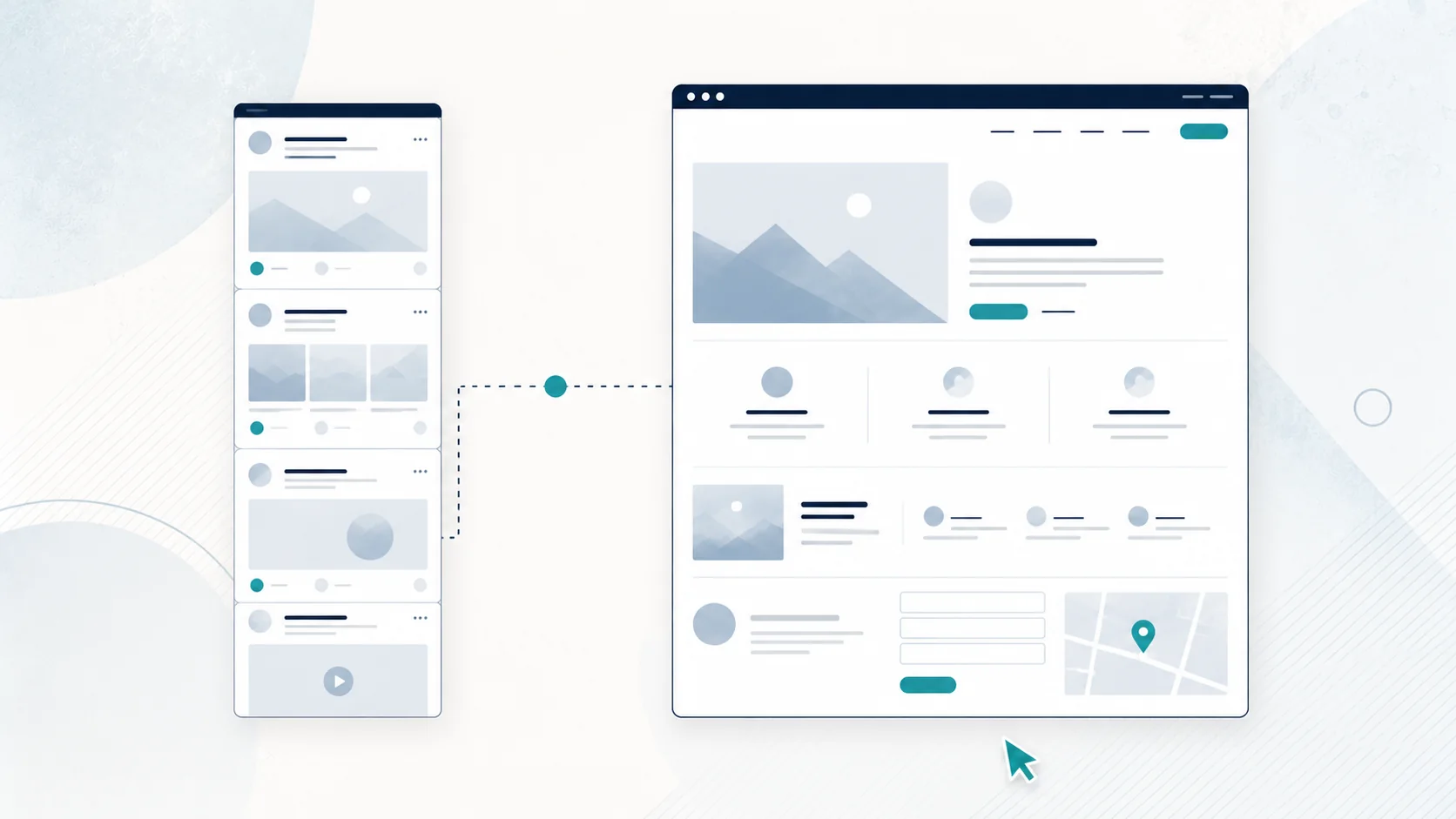
When Facebook alone can genuinely be enough
There is no benefit in telling every new business owner they urgently need a five-page website before they have made their first sale.
Facebook may be enough if:
- the business is brand new and you are testing demand
- almost all customers come through friends, community groups or referrals
- your offer is very simple
- you do not yet have much content, proof or service information to publish
- you have virtually no budget
- you are happy handling enquiries through Messenger, phone or comments
Imagine you have started doing weekend lawn mowing around your suburb. You have three regular customers, a few before-and-after photos and you are still deciding whether you want to turn it into a serious business.
A Facebook Page is a perfectly reasonable starting point.
The need for a website usually appears as the business becomes less experimental.
What Facebook does well for a small business
Facebook is useful because people already know how to use it.
It can be particularly good for:
- posting recent work
- sharing quick updates
- collecting comments and recommendations
- joining local community conversations
- answering messages
- showing that the business is active
- sharing promotions or availability
For a gardener, painter, cleaner or mobile mechanic, regular project photos can be valuable social proof. A customer can see that real work is happening without the business owner publishing a formal case study every week.
Facebook is also easy to update from a phone. That matters for small businesses that do not want to log into a website editor every time they finish a job.
What a website does differently
A website is better at being the organised, permanent explanation of your business.
A social feed is chronological. Important information gets pushed down as new posts appear.
A website can keep the main customer questions in predictable places:
Home: what the business does
Services: what customers can hire you for
About: who is behind the business
Projects or reviews: evidence
Contact: how to get in touch
That makes a website useful for people who are not interested in following you socially. They just want to know whether you can solve their problem.
Facebook Page vs website: what is each better at?
| Need | Facebook Page | Website |
|---|---|---|
| Quick posts and updates | Strong | Possible, but not its main strength |
| Community interaction | Strong | Limited |
| Messenger/social conversation | Strong | Limited |
| Clear service information | Moderate | Strong |
| Dedicated pages for different services | Limited | Strong |
| Longer project or case-study content | Possible but awkward | Strong |
| Control over layout and customer journey | Limited by Facebook | Strong |
| A stable home for your brand | Platform-dependent | Strong |
| Search-focused service pages | Limited | Strong |
| Enquiry forms tailored to the business | Limited | Strong |
| Reviews/social proof | Strong for social proof | Strong when placed in context |
Neither column wins every row. They are different tools.
The control difference matters, but do not overstate it
People often say, "You own your website, but Facebook owns your Page."
The practical version is more useful.
You can control the content you publish on your Facebook Page, but Meta controls the platform itself: the interface, available features, account rules, how feeds work and how people discover content.
With your own website, you have much more control over the structure, wording, navigation, calls to action and how information is presented.
That does not mean a website is magically independent of every third party. Websites still use domain registrars, hosting providers, software and services. The difference is that your business is not forced into one social platform's feed and page layout.
A sensible goal is to avoid making a single platform your entire online presence once the business becomes established.
What happens when someone Googles your business?
This is where the difference becomes more obvious.
A potential customer may hear your name from a friend, see a van, read a recommendation in a Facebook group or find you through Google. They then search the business name to check whether it looks legitimate and whether it offers what they need.
Your Facebook Page may appear in Google. So may directory listings, your Google Business Profile and other mentions.
A website gives you a first-party result you can organise around the questions that customer is asking.
It also lets you create distinct pages for real services. A builder can have a page about decks and another about renovations. A beauty business can explain treatments. A consultant can publish a detailed service page or case study.
That is much harder to reproduce cleanly in a social feed.
Does a website automatically make you rank on Google?
No.
Having a website gives Google pages it can discover and potentially index. It does not guarantee that those pages will rank for competitive searches.
A brand-new site can exist without immediately appearing for searches such as "builder Christchurch" or "accountant near me". Ranking depends on relevance, competition and many other signals.
This distinction matters because some business owners say "my website isn't on Google" when the site is actually indexed but simply does not rank for the phrase they are testing.
The article Why Is My Website Not Showing on Google? NZ Troubleshooting Guide separates those problems step by step.
What about Google Business Profile?
A Google Business Profile is another separate piece of the puzzle.
For eligible businesses, Google Business Profile is free and lets a business manage information that can appear on Google Search and Maps, including details such as hours, phone number, website, location or service area, photos and reviews.
For a local service business, that can be extremely valuable.
But a Business Profile is not simply a replacement website.
Think of the roles like this:
Google Business Profile: helps with local discovery on Google Search and Maps and gives customers quick business information.
Website: gives you controlled pages for services, proof, content and enquiries.
Facebook: gives you an active social channel for posts, updates and community interaction.
They can reinforce each other instead of competing.
A practical three-part setup
For many established NZ service businesses, a simple setup looks like this:
- Website as the home base
Keep the core information stable: services, areas served, About, projects/reviews and contact details.
- Google Business Profile for local discovery
Keep the profile accurate and complete, collect legitimate reviews and link people through to the website when they want more detail.
- Facebook for activity and social proof
Post recent jobs, updates and community content without expecting the feed to act as the entire business website.
A customer can discover you in Maps, check your website, then glance at Facebook to see recent work. Another customer may discover you on Facebook first and use the website to understand the service properly.
NZ example: a new home baker
A home baker just starting out may be fine with:
- Facebook Page
- simple order instructions
If orders mostly come from friends and local groups, there may be no urgent need for a website.
As the business grows, a website becomes more useful for a menu, ordering information, allergen notes, pickup details, FAQs and a more stable branded presence.
NZ example: a local tradie
A self-employed fence builder may get work from Facebook groups at first.
Once customers are comparing quotes, the questions change:
- What types of fences do you build?
- Which areas do you cover?
- Can I see previous work?
- Are you the same business someone recommended?
- How do I request a quote?
A website can answer those questions in one place while Facebook continues to show recent jobs.
NZ example: an independent consultant
For a consultant, Facebook may be less important than LinkedIn or referrals, but the principle is the same.
A website gives them room to explain a specialised service, show case studies, clarify who they work with and provide a professional page to send prospects after a conversation.
The website is not replacing social media. It is giving interested people somewhere to continue evaluating the business.
When is it worth adding a website?
Consider adding a website when several of these are true:
- strangers are searching your business name
- customers keep asking the same service questions
- you have enough photos, reviews or projects to show real proof
- you offer multiple services that deserve clear explanations
- you want enquiry forms or a more deliberate contact journey
- you are competing with established businesses that have clear websites
- you want a stable URL to put on signage, vehicles, quotes and email signatures
- you want to build search visibility beyond a social profile
- you are tired of important information disappearing down the Facebook feed
You do not need to wait until every box is ticked. The list is simply a way to identify when Facebook-only is starting to create friction.
If you need a website, do you have to hire a designer?
No.
You can build one yourself using a platform such as Wix if the requirements are simple and you have the time.
That is why the next useful comparison is Wix vs Web Designer: Which Is Better for an NZ Small Business?
Facebook can remain useful while the website gives a growing business a proper home base.